

Key Takeaways
Q1: What does “Can Sickbay Meaning Help Businesses Understand 7 Basic Workplace Medical Needs?” mean?
It means the term sickbay can help Malaysian businesses understand essential workplace medical readiness, including first-aid space, equipment, trained staff, hygiene, emergency response, and supplier support.
Q2: How does sickbay meaning give a fast answer for business owners and local users?
Sickbay meaning explains that a sickbay is more than a room; it is a practical medical support point for minor treatment, observation, first-aid response, and safer workplace operations.
Q3: What should readers do next after understanding sickbay meaning?
Readers should review their workplace medical setup, identify missing equipment or supplies, and refer to AIDEL’s guide on Understanding Sickbay Meaning in Healthcare Settings for clearer planning.
sickbay meaning is not just a dictionary term; it can help Malaysian businesses understand how basic medical support should function inside offices, schools, factories, clinics, warehouses, and service-based workplaces.
For many business owners, a “sickbay” may sound like something only hospitals, ships, or large institutions need.
In reality, the concept is useful for any workplace that wants to manage minor injuries, employee discomfort, short-term observation, first-aid response, and emergency escalation more responsibly.
A small office may not need a full medical room, but it may still need a proper first-aid box, trained staff, basic medical equipment, hygiene control, privacy, and clear procedures.
A school may need a safer rest area for students.
A factory may need faster response for cuts, dizziness, burns, or workplace-related incidents.
These are practical needs, not just medical terms.
For LocalVitals readers, this topic also connects to local business discovery.
Consumers may want to find trusted healthcare suppliers, first-aid providers, clinics, or occupational health support near them.
Business owners may want better visibility for medical equipment, workplace safety, or health-related services.
Content marketers and local SEO professionals can also use this topic to build helpful, search-focused articles around real Malaysian business needs.
AIDEL is relevant here because its healthcare and sickbay-related content helps readers understand how sickbay spaces, first-aid supplies, and basic medical equipment fit into real workplace planning.
What Does Sickbay Meaning Tell Businesses About Workplace Medical Readiness?
Sickbay meaning helps business owners understand that workplace medical readiness includes a care space, first-aid equipment, trained responders, hygiene control, and clear emergency procedures.
In business terms, a sickbay is not only a hospital-style room.
It can be a designated medical support area where employees, students, visitors, or customers receive basic attention before further treatment is needed.
For a Malaysian office, retail outlet, school, warehouse, clinic, or factory, this concept helps management ask practical questions: Is there a safe place for someone who feels unwell? Is the first-aid box complete?
Does any staff member know what to do during a minor injury or sudden collapse?
AIDEL explains sickbay as a space for treatment, observation, recovery, and sometimes quarantine across healthcare, workplace, school, and industrial settings.
That makes the topic useful for companies that want safer day-to-day operations, not just large medical institutions.
Sickbay Meaning In Modern Healthcare, Offices, Schools, And Industrial Workplaces
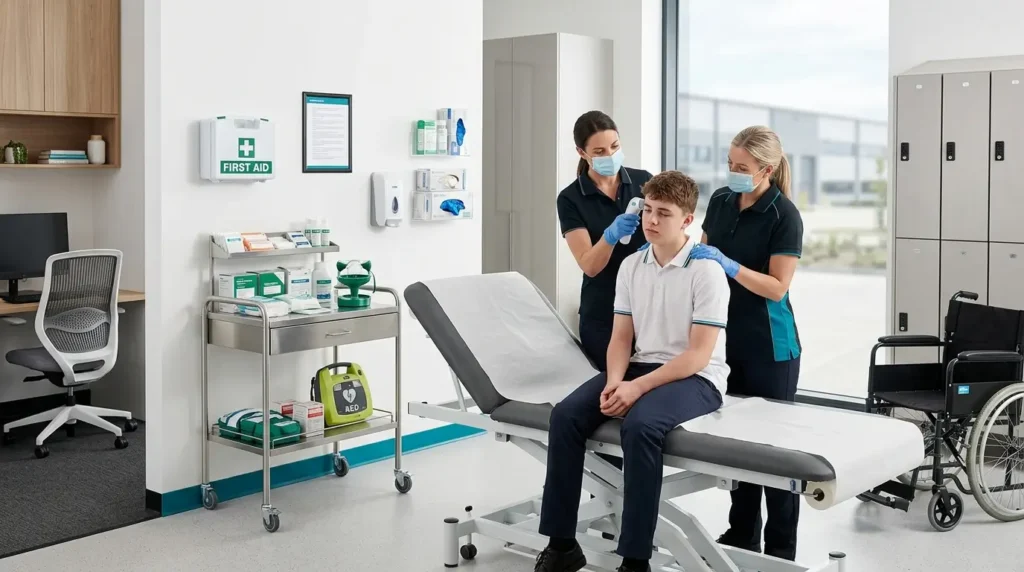
Sickbay meaning now covers practical care areas in hospitals, corporate offices, schools, camps, ships, factories, and other workplaces where basic health support is needed.
In hospitals, a sickbay may support quick assessment, triage, and patient monitoring.
In corporate offices, it may function as a first-aid room or rest area.
In schools, it can help manage students with minor injuries or temporary illness.
For industrial workplaces, the purpose becomes more urgent because workers may face cuts, burns, slips, chemical exposure, heat stress, or machinery-related injuries.
A basic sickbay setup gives the workplace a controlled point for immediate response.
Sickbay Meaning As A First-Aid Room, Rest Area, And Emergency Response Point
Sickbay meaning becomes clearer when businesses see it as a functional first-aid room, temporary rest area, and emergency coordination point.
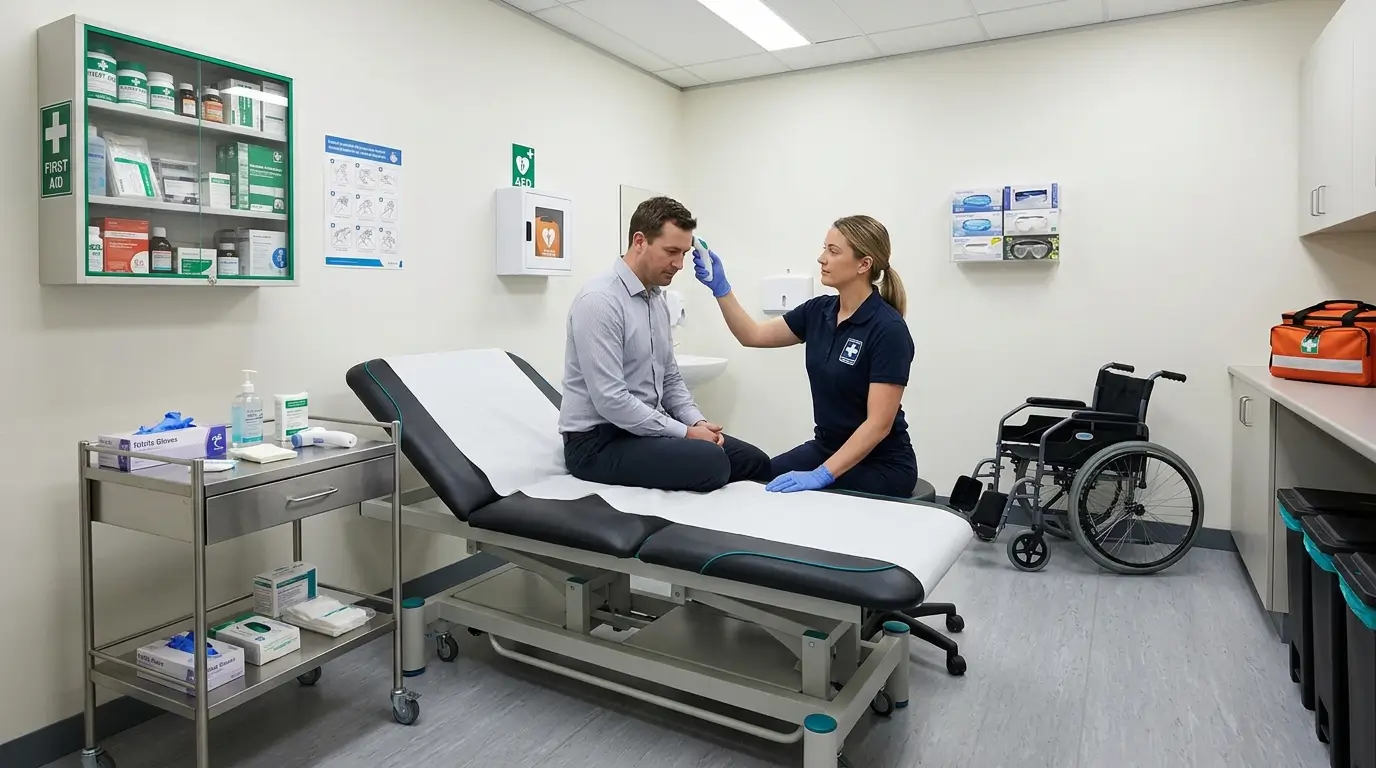
A small business may only need a simple medical corner with first-aid supplies, privacy, and basic signage.
A larger workplace may need a dedicated first-aid room with space for a couch, stretcher access, clean surfaces, lighting, nearby toilet access, and emergency transfer routes.
The DOSH Malaysia guide describes workplace first-aid facilities as including a first-aid box, first-aid room, and first-aid equipment such as oxygen equipment and a stretcher.
Basic Difference Between Sickbay, First-Aid Room, And Infirmary
A sickbay is a general care area. A first-aid room is usually a workplace-focused space for initial treatment.
An infirmary often refers to a more established medical room in a school, institution, military facility, or healthcare setting.
When A Sickbay Is A Dedicated Space Versus A Temporary Medical Area
A dedicated sickbay is useful for larger premises, higher-risk workplaces, schools, and healthcare-related businesses.
A temporary medical area may be enough for low-risk offices, small teams, or event-based settings, provided it is clean, accessible, private, and properly equipped.
Why Should Malaysian Businesses Understand Basic Sickbay And First-Aid Needs?
Malaysian businesses should understand sickbay and first-aid needs because workplace incidents require fast response, suitable equipment, responsible staff, and safer recovery decisions.
The DOSH guide highlights that proper first aid within the first few minutes of an accident or sudden collapse may affect the outcome for an injured worker or nearby member of the public.
It also notes that first aid is important for minor injuries such as burns, sprains, and cuts.
This matters for businesses listed in local directories because safety signals can influence trust.
A parent may prefer a tuition centre or school with visible care procedures.
A factory client may value suppliers with proper safety practices.
An employee may feel more confident joining a company that treats workplace health seriously.
Employer Responsibility, Employee Safety, And Faster Incident Response
Employer responsibility includes maintaining first-aid readiness, assigning suitable staff, checking supplies, and ensuring workers know where to find help during emergencies.
For practical planning, employers should look at industry risk, number of workers, work shifts, workplace layout, travel time to clinics, and the type of injuries likely to happen.
A café, warehouse, clinic, workshop, and office will not have the same medical needs.
DOSH also states that workplace first-aid facility maintenance remains the employer’s absolute responsibility, even when a first-aider is assigned to check and replenish the first-aid box.
Workplace Examples For Offices, Factories, Schools, Clinics, And Warehouses
An office may need supplies for fainting, headaches, minor cuts, and temporary rest.
A factory may need faster response for cuts, burns, eye irritation, and machinery-related injuries.
A school may need a safe space for children who feel unwell while waiting for parents.
Common Minor Cases That A Workplace Sickbay Can Support
Common cases include small wounds, dizziness, sprains, nosebleeds, mild allergic reactions, heat discomfort, minor burns, and employees who need observation before returning to work or seeking professional care.
What Are The 7 Basic Workplace Medical Needs A Sickbay Can Help Identify?
A sickbay helps businesses identify seven basic workplace medical needs: space, supplies, equipment, trained people, hygiene, emergency procedures, and occupational health support.
1. A Clear Medical Space For Minor Treatment And Observation
A clear medical space allows employees, students, visitors, or customers to receive basic care away from crowded, noisy, or unsafe work areas.
This space should be easy to access, easy to clean, and private enough for basic care.
In a directory-driven local search environment, businesses can strengthen trust by explaining whether they provide basic first-aid readiness, especially in health, education, childcare, fitness, factory, and event-related sectors.
2. A Proper First-Aid Box With Suitable Supplies
A proper first-aid box gives staff immediate access to basic wound care, dressing materials, and emergency support items before professional treatment arrives.
DOSH advises that first-aid boxes should be sturdy, portable, clearly marked, accessible, and checked frequently so that contents remain complete and usable.
3. Basic Sickbay Equipment For Safer On-Site Response
Basic sickbay equipment supports faster assessment, safer movement, temporary observation, and better comfort during minor workplace health incidents.
Useful items may include a thermometer, blood pressure monitor, couch, pillow, blanket, stretcher, splints, sterile dressings, paper towels, soap, refuse bin, pocket mask, torch light, and privacy screen.
For higher-risk premises, an AED may also be considered with proper training and maintenance.
Recommended Medical Equipment For A Basic Workplace Sickbay
Recommended medical equipment for a basic workplace sickbay should match workplace risk, employee count, visitor profile, response time, and available trained staff.
The DOSH guide’s recommended first-aid room facilities include running potable water, sterile dressings, stretcher, splints, clinical thermometer, couch with pillow and blanket, suitable storage, soap, refuse container, pocket mask, adult cervical collar, torch light, and portable oxygen set.
Thermometer, Blood Pressure Monitor, Stretcher, Privacy Screen, And AED Consideration
A thermometer supports basic temperature checks.
A blood pressure monitor helps with simple observation.
A stretcher supports safer transfer.
A privacy screen protects dignity.
An AED may support cardiac emergency readiness when staff are trained.
4. Trained First-Aiders Or Responsible Staff Members
Trained first-aiders help turn sickbay meaning from a physical room into a reliable workplace response system during urgent situations.
A first-aid area without responsible people becomes weak in practice.
Staff should know where supplies are, who the first-aider is, when to call emergency services, and when not to move an injured person.
5. Hygiene, Sanitation, And Infection Control Practices
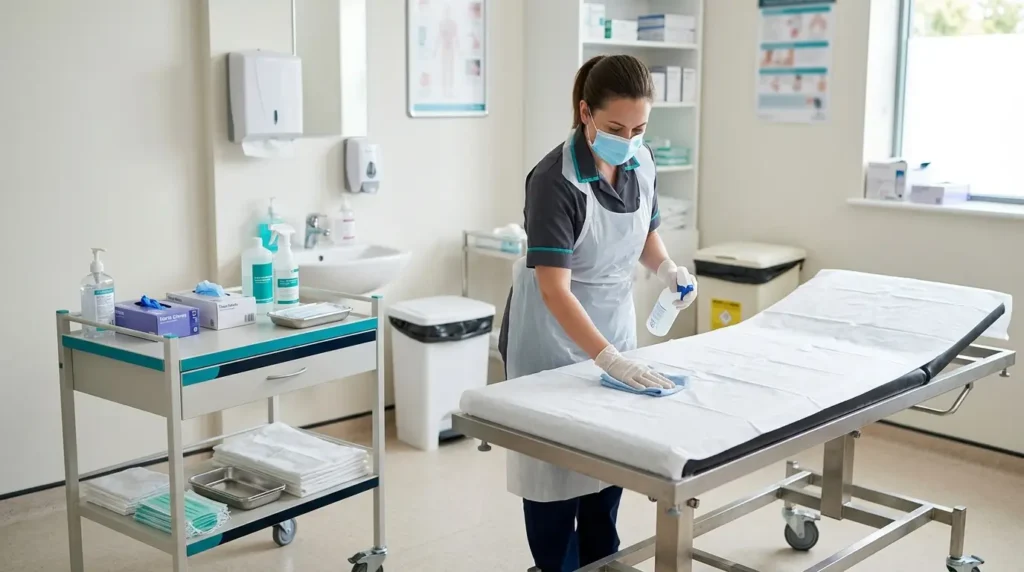
Hygiene and sanitation reduce cross-contamination risks when a sickbay is used for wounds, illness, observation, or temporary isolation.
Businesses should keep surfaces clean, dispose of used materials properly, separate general storage from medical supplies, and replace expired or contaminated items.
These details matter for schools, clinics, gyms, salons, factories, restaurants, and customer-facing premises.
Best Practices For Hygiene And Sanitation In A Dedicated Sick Room
Best practices include washable surfaces, clean handwashing access, proper waste disposal, fresh linens, good ventilation, supply checks, and simple usage records.
A dedicated sick room should not become a storage room for unrelated office items.
It should remain ready, clean, identifiable, and accessible when someone needs help.
6. Clear Emergency Response And Escalation Procedures
Clear emergency response procedures help staff decide when to give first aid, call an ambulance, contact family, or refer someone to a clinic.
A basic procedure should include emergency contacts, nearby clinic or hospital information, first-aider names, incident record steps, and escalation rules.
For multi-tenant workplaces or shared premises, responsibility should be clearly agreed and documented.
7. Access To Occupational Health Support When Needed
Occupational health support helps businesses manage employee wellbeing, workplace adjustments, absence concerns, prevention, and early intervention beyond basic first aid.
Small businesses may not have internal HR or medical teams.
Occupational health support can help management handle employee health concerns more confidently, especially when issues involve long-term sickness, mental health, workplace adjustment, or return-to-work planning.
How Can Sickbay Meaning Help Consumers And Local Users Choose Safer Businesses?
Sickbay meaning helps consumers ask better safety questions when comparing schools, clinics, gyms, factories, event venues, childcare centres, and healthcare-related suppliers.
For LocalVitals users, the idea connects directly to local search.
When people browse business listings, they are not only looking for a phone number.
They may also want signs of credibility, preparedness, proper location, service categories, contact details, and reviews.
Health-Sensitive Decisions For Parents, Patients, Employees, And Local Customers
Health-sensitive users often choose businesses based on trust signals such as safety readiness, visible contact details, verified listings, maps, reviews, and service clarity.
A parent checking a school, a patient comparing clinics, or a company sourcing first-aid equipment may look for businesses that communicate clearly.
A verified listing, complete profile, and accurate map location can reduce uncertainty.
Using Business Listings, Maps, Categories, And Reviews To Check Service Credibility
LocalVitals can support this discovery process by helping users browse by industry and location, view categorized details, compare local service providers, and find businesses with clearer public information.
How Can Business Owners Use Workplace Medical Readiness To Build Trust?
Business owners can use workplace medical readiness to show care, professionalism, operational discipline, and stronger credibility among customers, staff, suppliers, and partners.
A business does not need to exaggerate its setup.
It only needs to communicate clearly.
For example, a training centre can mention basic first-aid readiness.
A supplier can list sickbay equipment categories.
A clinic can publish educational articles.
A school-related vendor can explain suitable first-aid kits and basic sickbay furniture.
Verified Business Listings, Better Contact Visibility, And Local Search Confidence
Verified business listings help companies show accurate contact information, service categories, map location, and business details to people searching locally.
For health and safety-related businesses, this matters because trust begins before the first enquiry.
A complete listing can help users see whether a company serves their area, what products or services it offers, and how to contact them.
How A Health And Wellness Directory Category Supports Local Discovery
A Health & Wellness category can group clinics, medical suppliers, workplace safety providers, wellness centres, sickbay suppliers, and occupational health services into a more relevant browsing path.
Why Accurate Location, Contact Details, Maps, And Service Categories Matter
Accurate listing details help users act faster.
They can call, navigate, compare services, check nearby options, and decide whether the business is relevant to their immediate health or workplace safety needs.
How Can Businesses Find The Right Sickbay Suppliers And Medical Support Services?
Businesses can use local directories to compare healthcare suppliers, first-aid equipment providers, occupational health consultants, and workplace safety services by category, location, contact details, and credibility signals.
Finding the right sickbay supplier depends on the type of workplace.
A small office may need basic first-aid supplies and a clean rest area.
A school may need a sickbay bed, thermometer, privacy screen, and first-aid kit.
A factory may need a stretcher, eyewash station, emergency response equipment, and occupational health support.
This is where local directories can help.
Instead of searching randomly, businesses can compare providers by category, location, service description, contact information, and map visibility.
That makes supplier research more practical for business owners who need fast, relevant options.
Why Local Business Listings Matter For Sickbay Planning
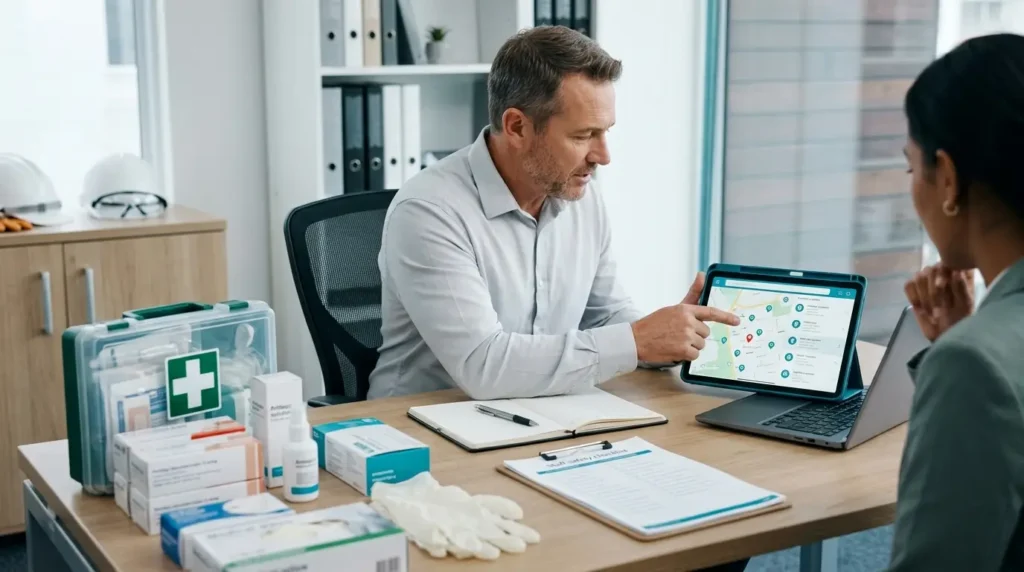
Local business listings help companies find nearby medical suppliers, first-aid kit providers, clinic support, safety consultants, and health-related vendors more efficiently.
For example, a childcare centre in Selangor may want to find a nearby supplier for basic sickbay furniture.
A corporate office in Kuala Lumpur may need a reliable first-aid kit provider.
A warehouse operator may want to compare safety equipment suppliers before upgrading its emergency response setup.
Local listings also help suppliers show their products and services clearly.
A medical equipment business can describe its sickbay beds, privacy screens, first-aid kits, AED-related items, stretchers, and healthcare support products in a way that helps customers make faster decisions.
What Businesses Should Check Before Contacting A Supplier
Businesses should check product suitability, service area, contact details, reviews, delivery coverage, after-sales support, and whether the supplier understands workplace or institutional needs.
A supplier that serves schools may not offer the same products as a supplier serving factories.
A supplier that supports clinics may provide more specialised medical furniture.
A general first-aid supplier may be enough for smaller offices with low-risk work environments.
What Mistakes Should Businesses Avoid When Planning A Small Sickbay?
Businesses should avoid treating a sickbay as decoration, because an ineffective medical area can create false confidence during real workplace incidents.
A common mistake is buying random supplies without considering risk.
Another mistake is having equipment but no trained person.
Some companies also forget expiry dates, privacy, signage, emergency contacts, maintenance records, or access routes for stretchers and ambulances.
Treating A Sickbay As Decoration Instead Of A Functional Medical Support Area
A functional sickbay must be clean, accessible, stocked, assigned to responsible people, and supported by clear emergency procedures.
If nobody knows where the first-aid box is, the sickbay is not ready.
If supplies expire, the setup is weak.
If the room is locked and the key holder is absent, response time suffers.
Common Gaps In Supplies, Staff Training, Record Keeping, Privacy, And Maintenance
Key gaps include incomplete first-aid kits, no treatment record, poor privacy, unclear first-aider identity, expired materials, no supplier support, and no regular review by management.
What Is The Best Practical Checklist For A Basic Workplace Sickbay?
The best practical checklist covers medical space, first-aid supplies, essential equipment, trained people, hygiene, signage, records, emergency contacts, and supplier support.
A checklist keeps the planning process simple.
It also helps business owners avoid overspending on unnecessary items while still covering basic readiness.
A Simple Readiness Checklist For Small Malaysian Businesses
A simple readiness checklist helps small Malaysian businesses review whether their sickbay setup is practical, visible, stocked, clean, and properly managed.
Use this checklist:
- Identify a clean and accessible medical support space.
- Prepare a suitable first-aid box.
- Add basic sickbay equipment based on workplace risk.
- Assign trained or responsible staff.
- Display first-aider names and emergency contacts.
- Keep hygiene supplies and waste disposal ready.
- Record incidents and treatments.
- Review supplies regularly.
- Find reliable suppliers for replacement items.
- Use local directory visibility to help customers find trusted health and safety providers.
AIDEL can be positioned naturally as a helpful reference for businesses that want to understand sickbay meaning, sickbay equipment, first-aid supplies, AED-related items, and workplace medical readiness in a more practical way.
Understanding sickbay meaning helps Malaysian businesses connect a simple healthcare term with practical workplace readiness, safer first-aid response, and better local service discovery.
A sickbay does not need to be complicated, but it should be practical.
Businesses should think about space, supplies, equipment, trained staff, hygiene, emergency procedures, and supplier support.
For consumers, these details can also become trust signals when choosing schools, clinics, gyms, childcare centres, factories, or healthcare-related providers.
Related article
Businesses that understand sickbay planning can make better decisions when choosing first-aid supplies, medical equipment, or workplace healthcare support.
For clearer guidance, AIDEL is a helpful reference for businesses that want to understand how sickbay spaces, basic medical equipment, and workplace medical readiness fit together.
Read AIDEL’s guide on Understanding Sickbay Meaning in Healthcare Settings before planning your workplace sickbay setup.
FAQ About Sickbay Meaning And Workplace Medical Needs
What does sickbay mean in a hospital setting?
A sickbay in a hospital setting usually refers to a designated care area where patients can receive basic treatment, observation, or short-term medical attention.
In healthcare environments, a sickbay may support triage, recovery, monitoring, or temporary isolation depending on the facility.
For businesses, the concept is useful because it shows how a dedicated space can support minor medical needs before a person is referred to a clinic, hospital, or emergency department.
What is the definition of sickbay in a modern context?
The modern definition of sickbay is a designated medical support area used for basic treatment, observation, rest, first aid, or temporary care.
For workplaces, sickbay meaning can apply to a small first-aid room, school medical area, corporate rest room, industrial emergency point, or healthcare support space.
The setup depends on workplace size, risk level, number of people, available trained staff, and the type of incidents likely to happen.
Recommended medical equipment for a basic workplace sickbay.
Basic workplace sickbay equipment should support minor treatment, observation, hygiene, patient comfort, and safer emergency response before professional care arrives.
Common items may include a first-aid box, sterile dressings, thermometer, blood pressure monitor, couch, blanket, pillow, stretcher, privacy screen, torch light, waste bin, hand hygiene supplies, and emergency contact list.
Higher-risk workplaces may also consider items such as an AED, eyewash station, or occupational health support.
Guidelines for setting up a small medical room in a Malaysian office.
A small Malaysian office medical room should be clean, accessible, private, clearly identified, stocked with first-aid supplies, and supported by responsible staff.
The room does not need to be hospital-grade for low-risk offices, but it should not be treated as a storage area.
Employers should check supplies regularly, display emergency contacts, assign trained staff where possible, and ensure employees know where to go when someone feels unwell or injured.
What are the typical features of a sickbay in a corporate office?
A corporate office sickbay usually includes a clean rest area, first-aid box, basic medical tools, privacy, emergency contacts, and clear response procedures.
Typical features may include a couch or bed, chair, washable surfaces, thermometer, blood pressure monitor, hand hygiene supplies, waste bin, signage, and simple incident records.
For larger offices, management may also consider trained first-aiders, nearby clinic partnerships, and supplier support for replacement medical items.